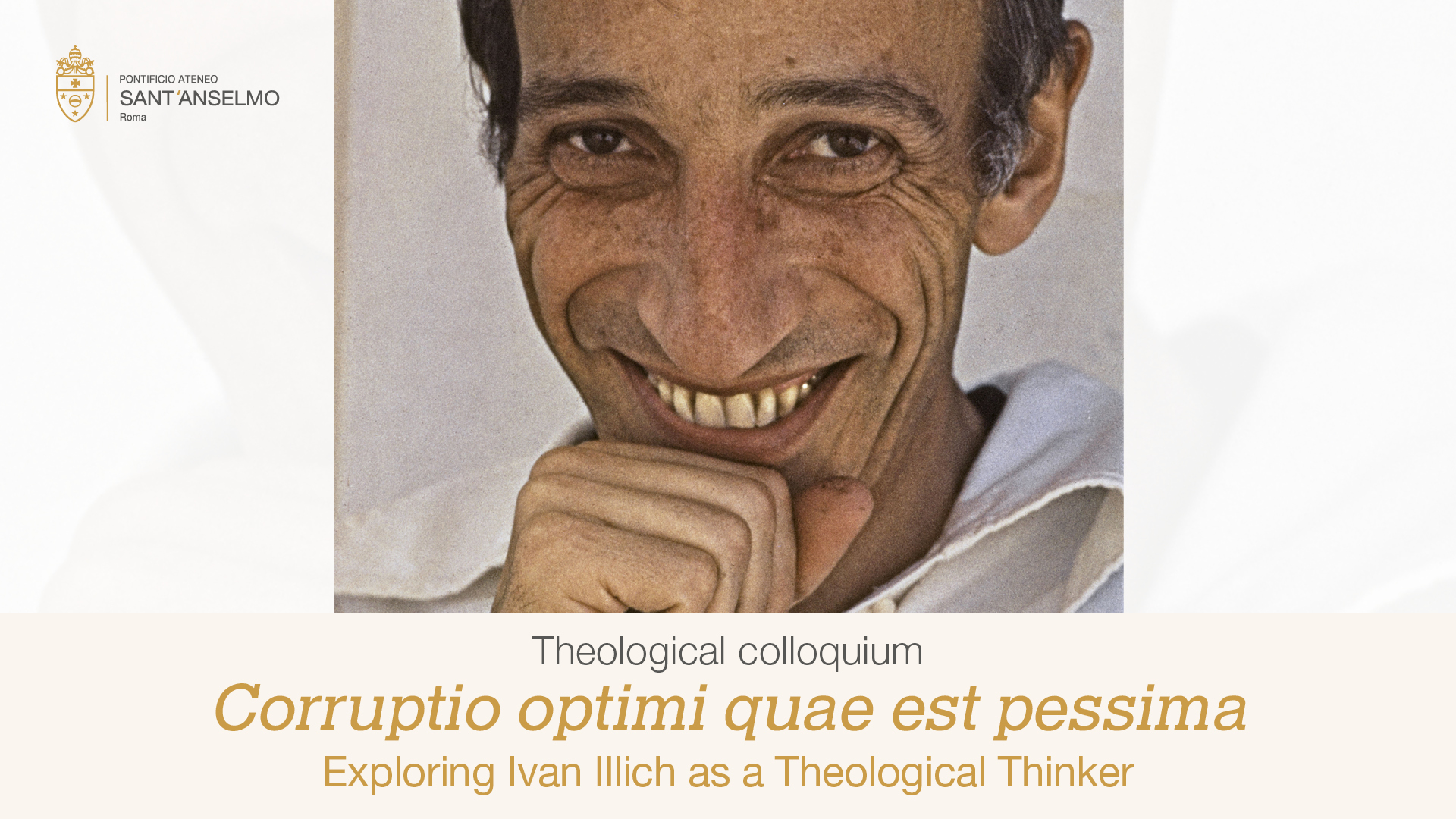
We are pleased to announce an upcoming international theological colloquium, "Corruptio optimi quae est pessima: Exploring Ivan Illich as a Theological Thinker," taking place from May 14th to 16th, 2026. This event represents a unique inter-university collaboration between the Pontificio Ateneo Sant’Anselmo, the Pontificia Università Gregoriana, the Collège des Bernardins, and Uppsala University.
This colloquium invites participants to read Ivan Illich as a theological thinker of modernity. In his conversations with David Cayley, Illich argues that the modern world becomes intelligible only when understood as both an extension and a perversion of the Christian message. This is not merely a polemical thesis but a method of discernment. His analysis traces a genealogy of evangelical corruptions: charity becomes administered service, hospitality becomes hospitalization, care becomes sanitary management, teaching becomes compulsory schooling, mission becomes development. What once arose from gratuity, relation, and personal responsibility is thus absorbed into apparatuses that promise the good while organizing its corrupted form. Illich offers no programme. He proposes instead a critical practice of perception: stripping words bare, identifying thresholds of inversion, defending the vernacular, speaking from the margins without turning them into authority. His work enacts a theology of lucidity - at once ascetic and prophetic - grounded in what is fragile, embodied, and exposed. The colloquium seeks to examine this method and its contemporary urgency: Where do vernacular spaces still remain beyond administration? What kind of theology may emerge outside dispositifs of control? And how can resistance endure without itself being captured by processes of institutionalisation? To read Illich today is to learn how to name the corruption of the good without reproducing it.
Participation Details
-
Locations: The event will be hosted at the Pontificio Ateneo Sant'Anselmo and the Pontificia Università Gregoriana in Rome.
-
Format: Participation is available both in person and online.
-
Language: The main language is English, with simultaneous translation provided for Italian contributions.
-
Registration: There is no fee to attend, but registration is required by May 10th, 2026. Complete the registration form.
Flyer
Poster