
 Tra custodia e trasformazione
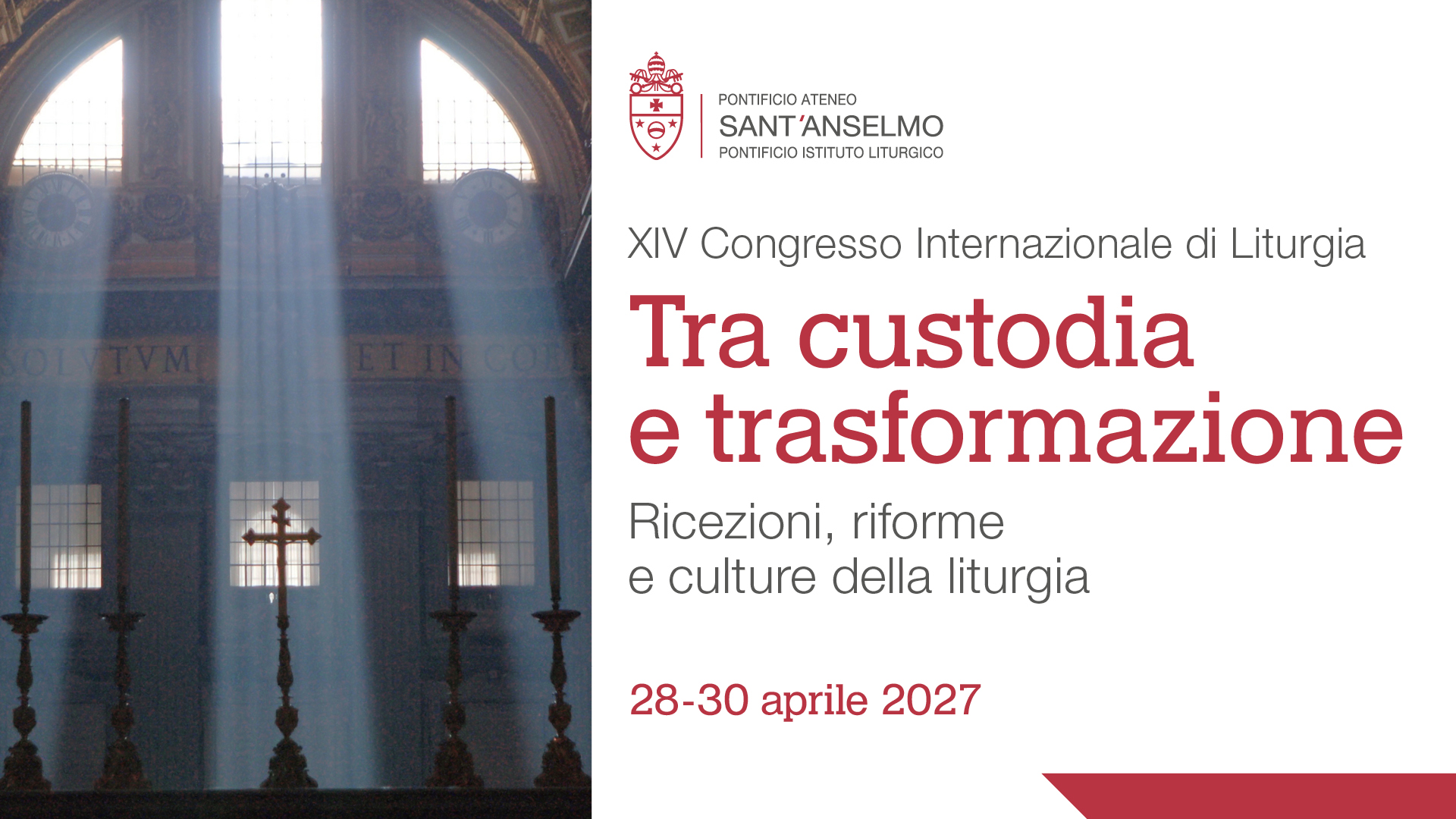
Ricezioni, riforme e culture della liturgia
XIV Congresso Internazionale di Liturgia
28-29-30 aprile 2027
Invitiamo tutti gli interessati a partecipare attivamente inviando le proprie proposte di intervento.
Aree tematiche
- Prospettiva storica – Riforme liturgiche, mutamenti rituali, processi di ricezione nel tempo
- Teologia ed ermeneutica – Tradizione e progresso, continuità e riforma, teologia delle riforme liturgiche
- Antropologia culturale e ricezione – Liturgia e culture, ricezione nelle comunità ecclesiali
- Inculturazione – Incontro tra liturgia e mondi culturali viventi; dinamiche di adattamento e creatività rituale
- Famiglie liturgiche – Riti orientali, tradizione ambrosiana, mozarabica e altre tradizioni occidentali; prospettiva comparativa
- Prassi celebrativa e pastorale – Ricezione contemporanea, formazione liturgica, dimensione comunitaria
Le lingue principali del Congresso sono l’italiano e l’inglese. È possibile proporre contributi anche in altre lingue, la cui approvazione sarà valutata dal comitato scientifico.
Gli interessati potranno inviare una proposta di intervento (titolo e abstract di 300 parole) entro il 6 dicembre 2026 tramite apposito MODULO ONLINE oppure all’indirizzo email: Questo indirizzo email è protetto dagli spambots. È necessario abilitare JavaScript per vederlo..
Il Congresso si terrà a Roma presso il Pontificio Istituto Liturgico del Pontificio Ateneo Sant’Anselmo in presenza (Piazza dei Cavalieri di Malta, 5 – 00153 Roma).
Tra custodia e trasformazione: lungi dall'essere una contraddizione da risolvere, questa tensione esprime il dinamismo proprio della vita liturgica della Chiesa. Custodire significa alimentare una memoria viva che cresce nel tempo, mentre trasformare è accompagnare questa stessa linfa verso nuove fioriture, in perfetta continuità con le sue radici. È proprio in questo spazio fecondo che prendono forma i grandi processi di ricezione, riforma e inculturazione che attraversano la storia cristiana.
Lo ha ricordato anche Papa Leone XIV nella catechesi del 27 maggio 2026, sottolineando come la liturgia sappia sempre incarnarsi «nelle forme culturali di ciascuna epoca». Il Pontefice ha ripreso un'efficace immagine espressa da Benedetto XVI nel 2011, per il cinquantesimo anniversario del Pontificio Istituto Liturgico, quella del «fiume della tradizione», che custodisce in sé la propria sorgente mentre scorre aperto verso la foce. In questo orizzonte, fedeltà e rinnovamento smettono di contrapporsi per integrarsi pienamente in un unico, vitale cammino.
Il Congresso si propone di articolare questo dinamismo attraverso le tre categorie programmatiche espresse nel titolo: ricezioni, riforme e culture.
Le ricezioni spostano l'attenzione verso le comunità: un cammino di accoglienza, interpretazione e confronto che si snoda anche attraverso resistenze, rifiuti, appropriazioni parziali e conflitti di autorità – dinamiche da cui scaturiscono comunque percorsi plurali e diversificati, la cui stessa conflittualità costituisce materia degna di indagine scientifica.
Le riforme delineano invece i grandi interventi istituzionali che hanno ridisegnato le forme rituali nel corso dei secoli – dalle revisioni medievali fino alla stagione postconciliare – indagate nelle loro motivazioni, nei loro meccanismi e nelle loro conseguenze storiche.
Le culture, infine, sono còlte nella loro ricca polisemia: mondi di vita, sensibilità d'epoca e identità proprie delle diverse famiglie liturgiche. In questo quadro, l'inculturazione si manifesta come un autentico processo di incontro e di reciproco arricchimento tra il mistero celebrato e il contesto culturale vivente.
L'orizzonte della ricerca non si limita al rito romano: le tradizioni delle Chiese orientali cattoliche, il rito ambrosiano, l’ispano-mozarabico e le altre famiglie liturgiche dell'Occidente e dell'Oriente sono parte integrante e fondamentale dell'indagine.
Resta aperto – e proprio per questo particolarmente fecondo per la ricerca – l'interrogativo su dove la ricezione cessi di essere semplice accoglienza per divenire essa stessa riforma, e su come la categoria di «cultura», nella sua stessa polisemia, possa ancora reggere alle domande che la contemporaneità le rivolge.
Con queste premesse, il Congresso si rivolge agli studiosi di liturgia e di tutte le discipline affini. I contributi potranno sviluppare prospettive storiche, teologico-sistematiche, antropologico-culturali, comparative o pastorali, promuovendo una partecipazione internazionale che sappia rispecchiare e valorizzare la pluralità dei contesti ecclesiali in cui la liturgia è quotidianamente vissuta e studiata.
Between Stewardship and Transformation
Receptions, Reforms, and Cultures of the Liturgy
14th International Congress on Liturgy
28–29–30 April 2027
We invite all those interested to actively participate by submitting their paper proposals.
Themes:
- Historical perspective – Liturgical reforms, ritual change, processes of reception over time
- Theology and hermeneutics – Tradition and progress, continuity and reform, theology of liturgical reforms
- Cultural anthropology and reception – Liturgy and cultures, reception within ecclesial communities
- Inculturation – Encounter between liturgy and living cultural worlds; dynamics of adaptation and ritual creativity
- Liturgical families – Eastern rites, the Ambrosian and Mozarabic traditions, and other Western traditions; comparative perspective
- Celebratory and pastoral practice – Contemporary reception, liturgical formation, communal dimension
The principal languages of the Congress are Italian and English. It is also possible to propose contributions in other languages, the approval of which will be evaluated by the scientific committee.
Those interested may submit a paper proposal (title and abstract of 300 words) by December 6, 2026, via the ONLINE FORM or to Questo indirizzo email è protetto dagli spambots. È necessario abilitare JavaScript per vederlo.
The Congress will take place in Rome at the Pontificio Istituto Liturgico of the Pontificio Ateneo Sant’Anselmo (Piazza dei Cavalieri di Malta, 5 – 00153 Rome), in-person format.
Between stewardship and transformation: far from being a contradiction to resolve, this tension expresses the very dynamism proper to the Church's liturgical life. To steward means to nourish a living memory that grows over time, while to transform is to guide this same sap toward new blossoms, in full continuity with its roots. It is precisely within this fruitful space that the great processes of reception, reform, and inculturation running through Christian history take shape.
Pope Leo XIV recalled this very dynamic in his catechesis of 27 May 2026, observing that the liturgy always knows how to take flesh "within the cultural forms of each age." In doing so, the Pontiff echoed a powerful image that Benedict XVI had proposed in 2011, on the occasion of the fiftieth anniversary of the Pontifical Liturgical Institute of Sant'Anselmo: that of the 'river of tradition,' which carries its source within itself even as it flows openly toward the sea. Within this horizon, fidelity and renewal cease to stand opposed to one another and instead become fully integrated within a single, living path.
The Congress proposes to articulate this dynamism through the three programmatic categories named in its title: receptions, reforms, and cultures.
Receptions turn attention toward the communities themselves: a path of welcome, interpretation, and engagement that unfolds also through resistance, refusal, partial appropriation, and conflicts of authority–dynamics from which plural and diversified itineraries nonetheless emerge, and whose very conflictual character is itself a legitimate object of scholarly inquiry.
Reforms, by contrast, trace the great institutional interventions that have reshaped ritual forms across the centuries–from medieval revisions to the postconciliar season–which can be examined in their motivations, mechanisms, and historical consequence.
Cultures, finally, are grasped in their rich polysemy: worlds of life, age‑specific sensibilities, and identities shaped by the different liturgical families. Within this horizon, inculturation appears as a genuine process of encounter and mutual enrichment between the mystery celebrated and the living cultural context.
The horizon of this research is not confined to the Roman rite: the traditions of the Eastern Catholic Churches, the Ambrosian and Hispanic-Mozarabic rites, and the other liturgical families of East and West form an integral and essential part of the inquiry.
An open question remains – and for that very reason is particularly fruitful for research – as to where reception ceases to be mere welcome and becomes itself a reform, and as to how the category of "culture," in its very polysemy, can still withstand the questions that contemporary scholarship now puts to it.
With these premises, the Congress addresses itself to scholars of liturgy and all related disciplines. Contributions may develop historical, theological-systematic, anthropological-cultural, comparative, or pastoral perspectives, fostering an international participation able to reflect and value the plurality of ecclesial contexts in which liturgy is daily lived and studied.